


Six months ago we wrote about Hurricane Melissa and what it meant for Jamaica’s food supply. That article remains unpublished and we were in the thick of it then, parsing damage figures, mapping parish losses, urging government and citizens alike to act fast and think ahead. Some of what we warned about came to pass. Some of what we hoped for is happening. And now, with hurricane season opening in less than a month, a second global shock has arrived, born thousands of miles away in a strait most Jamaicans have never heard of, but landing squarely in our supermarkets, on our farms, and in the plans of every family trying to rebuild.
This piece looks back at Melissa with fresh data, takes stock of where recovery genuinely stands, and turns to face what is coming. The data is alarming enough on its own and why we feel the need to ensue this article does not go unseen. What we want to do is help you see the full picture, clearly and early, before the window closes.
Looking Back: What Melissa Actually Did
When Melissa made landfall in late October 2025, we described it in near real-time terms: crops destroyed, roads severed, markets empty, 70,000 farmers impacted across more than 41,000 hectares of land. Those early figures were sobering. The revised picture, confirmed across multiple institutions, is worse.
The Inter-American Development Bank put total damage at US$12.2 billion, equivalent to approximately 56.7% of Jamaica’s 2024 GDP. For context, Hurricane Gilbert caused damage estimated at 65% of GDP in 1988. Melissa came close to that threshold, but unlike Gilbert, it landed on a country still recovering from Hurricane Beryl in 2024. Some communities had not fully bounced back when Melissa’s eye passed over. That compounding matters enormously (Inter-American Development Bank [IDB], 2026).
The agricultural sector took a disproportionate hit. The government’s initial estimate of J$29.5 billion in agricultural losses (roughly US$183 million) captured the immediate devastation (USDA Foreign Agricultural Service [FAS], 2025). The Bank of Jamaica later revised total sector losses to approximately 50% of the sector’s entire 2024 output. The parish-level picture told the real story of where the breadbasket was broken.
Table 1: Parish Impact Assessment and High-Risk Food Items, Hurricane Melissa (2025)
| Parish | Impact Level | High-Risk Food Items |
|---|---|---|
| St. Elizabeth | Catastrophic | Tomatoes, scallions, onions, scotch bonnet peppers, carrots, cabbage, chicken, eggs |
| Westmoreland | Catastrophic | Rice, tilapia, shrimp, sugarcane |
| St. Ann and Trelawny | Severe | Oranges, coconuts, bananas, yams |
| Clarendon | Severe | Oranges, sugarcane, grapefruit, hot peppers |
| St. James | Severe | Coffee, coconuts, vegetables (tourism supply) |
| St. Catherine | High | Lettuce, cucumber, melons, tilapia, eggs |
| Manchester | High | Irish potatoes, carrots, coffee |
Sources: USDA Foreign Agricultural Service (2025); MonaGIS (2025); Jamaica Observer (2025)
The supply chain failure compounded the shortage. Damaged roads severed the link between farming parishes and urban markets. Packaging facilities were offline. Fuel shortages meant that what little food remained in western Jamaica could not always move. The manufacturing sector reported J$250 billion in damages to the Jamaica Manufacturers and Exporters Association (JMEA), straining distribution further (Jamaica Observer, 2025a). Price gouging emerged quickly. Emergency importation of onions, potatoes, and eggs was announced. And yet the system held, not easily, and not without real suffering, but it held.
Taking Stock: Where Recovery Stands
Six months later, the picture is one of genuine progress alongside persistent fragility. Honest accounting of what has and has not been fixed is the only foundation for meaningful planning.
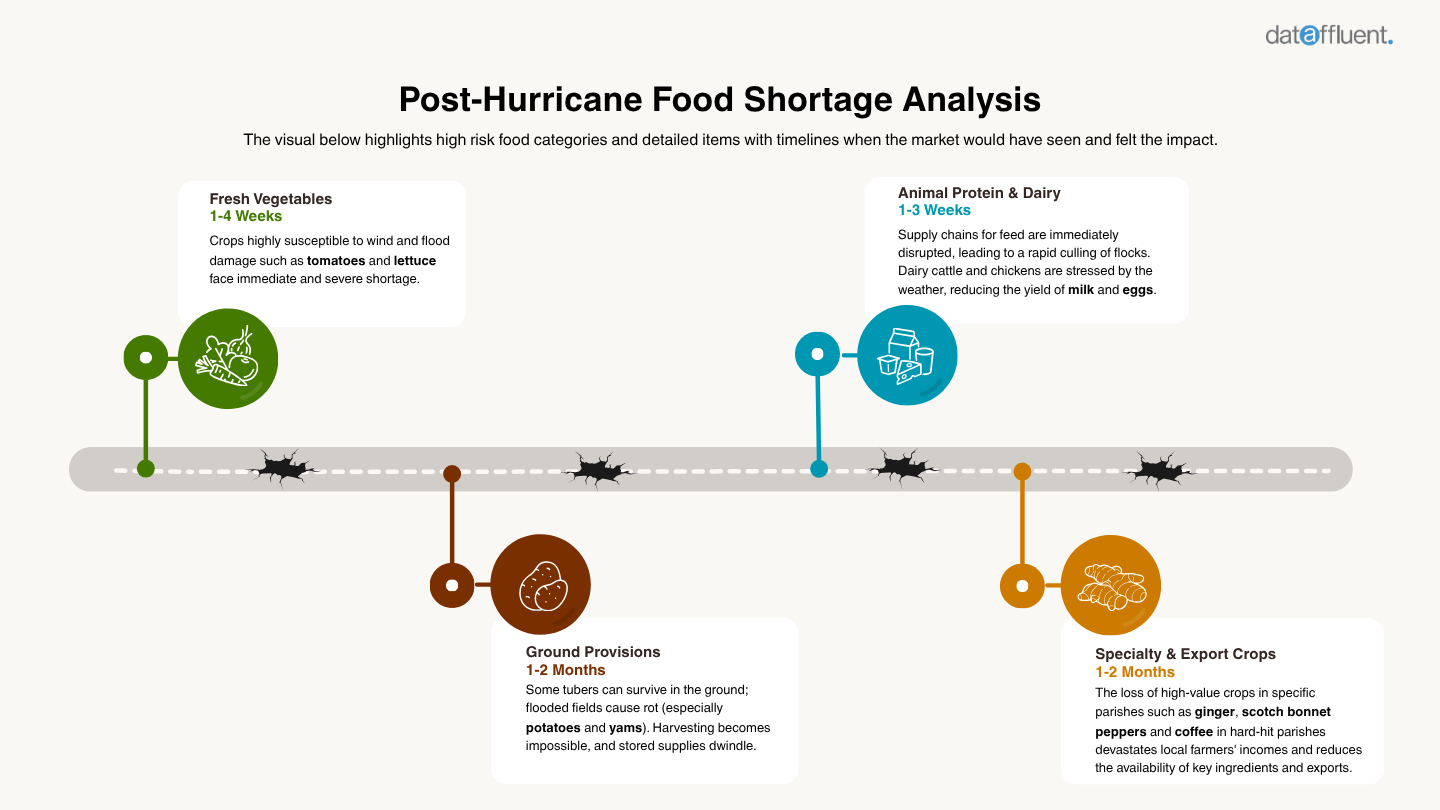
What Has Been Done
The government’s $3 billion Hurricane Melissa Disaster Recovery Programme has reached over 70,000 farmers and fishers, restoring 4,600 hectares of farmland, preparing 1,625 hectares of new land for over 2,000 farmers, and distributing seeds, planting materials, and livestock support across affected parishes. Fishing licence fees for more than 1,000 fishers were waived. A $40 million lease moratorium was implemented. The Ministry of Agriculture committed $180 million to restore coastal infrastructure and delivered new fishing vessels under the Fisheries Production Incentive Programme (Ministry of Agriculture, Fisheries and Mining [MAFM], 2026a).
Jamaica’s disaster risk financing framework mobilised up to US$662 million in government resources and financing. The IMF approved an additional US$415 million disbursement in January 2026, bringing total available recovery resources to over US$1 billion (International Monetary Fund [IMF], 2026). The World Bank catastrophe bond was fully triggered by Melissa (IDB, 2026). Electricity reached 98% of connections and water 97% by March 2026, when Prime Minister Holness officially declared Jamaica had entered the reconstruction phase. The 24,500 sq ft Essex Valley Cold Storage and Agro-Processing Facility in St. Elizabeth became operational with cold storage for 20+ containers, processing capabilities, and an administrative hub for agricultural services. This is a long-term investment and one we had specifically mentioned in our Melissa piece (MAFM, 2026b).
What Has Not Recovered
Despite the progress, the IFRC (International Federation of Red Cross and Red Crescent Societies), Jamaica Red Cross, CARE, and WFP (World Food Programme) are consistent in their April 2026 assessments: food security remains worse than before Melissa. A WFP report found that one third of households are not consuming enough fruits and dairy products weekly. Thousands of families are still displaced or living in damaged homes. Income losses in agriculture and tourism continue to hit rural and coastal communities hardest (CARE, 2026; International Federation of Red Cross and Red Crescent Societies [IFRC], 2026).
Specialty and export crops, scotch bonnet peppers, ginger, coffee, and cocoa, remain the slowest to recover. Replanting now does not mean revenue this year. They define both farmer incomes and Jamaica’s export identity, and they are still rebuilding.
The private sector’s $80 million gift card programme through American Friends of Jamaica and Hardware and Lumber reached roughly 1,600 small farmers, meaningful but a fraction of the 70,000 impacted. The gap between what has been committed and what has reached the ground-level farmer remains wide (Jamaica Observer, 2026a).
Table 2: Recovery Status by Food Category, Six Months After Melissa (May 2026)
| Category | Initial Timeline | Status: May 2026 |
|---|---|---|
| Fresh vegetables | 0 to 4 weeks | Acute shortage resolved. Prices easing. Replanting underway but full recovery protracted. |
| Staples and ground provisions | 1 to 2 months | Partially recovered. Essex Valley storage now operational. Some flooded fields still out of production. |
| Animal protein and dairy | 1 to 3 weeks | Recovering. Poultry sector rebuilding. Feed supply chains partly normalised. |
| Specialty and export crops | 1 to 2 months | Still rebuilding. Scotch bonnet, ginger, coffee on long recovery cycles. Farmer income still suppressed. |
Sources: CARE (2026); IFRC (2026); Jamaica Observer (2026a); USDA FAS (2025)
The New Shock: What Hormuz Has to Do With Us
On February 28, 2026, the United States and Israel launched strikes on Iran. Within days, shipping through the Strait of Hormuz collapsed. UNCTAD confirmed that daily vessel transits dropped from an average of 103 in the final week of February to single digits within weeks (UN Trade and Development [UNCTAD], 2026).
Most people heard this as an oil and gas story. For anyone thinking about food security in a small island state that imports most of its agricultural inputs, the fertiliser dimension is what demands attention.
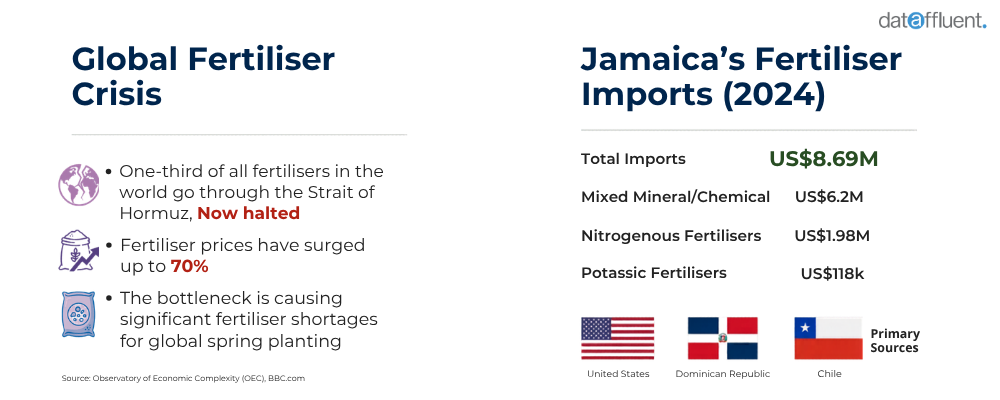
Roughly one third of globally traded fertiliser passes through the Strait of Hormuz. The Gulf region produces nearly half the world’s urea and significant shares of ammonia and phosphate, the core inputs for the nitrogen and compound fertilisers Jamaican farmers depend on. When the strait effectively closed, around 30% of globally exportable fertiliser supply left the market (Food and Agriculture Organization of the United Nations [FAO], 2026).
The price response was immediate. Granular urea in Egypt, the standard bellwether for nitrogen fertiliser prices, jumped from US$400 to US$490 per metric ton before the conflict to approximately US$700 within weeks (CNBC, 2026). The World Bank projects urea prices could end 2026 some 60% higher than 2025 levels (World Bank, 2026). The FAO warned that global fertiliser prices could average 15 to 20% higher for the first half of 2026, with the crisis already running longer than the short-term scenario in which markets might self-correct quickly (FAO, 2026).
Russia then suspended exports of ammonium nitrate, and China moved to restrict phosphate exports, removing roughly 25% of global phosphate supply. The secondary responses mirror what happened in 2022 after Russia’s invasion of Ukraine. Yara International, one of the world’s largest fertiliser producers, described the situation bluntly in its Q1 2026 investor report: reduced fertiliser availability could cost the world up to ten billion meals (Food Ingredients First, 2026).
Why This Lands Especially Hard on Jamaica Right Now
Jamaica imports most of its agricultural inputs. Farmers already stretched thin by Melissa’s capital losses are entering a planting season where the inputs they need to recover are materially more expensive than at any point in the previous growing cycle.
This is not a future risk. The crop cycle that will determine Jamaica’s domestic food supply through late 2026 and into early 2027 is being planted now. A farmer in St. Elizabeth or Manchester who cannot absorb a 30 to 50% increase in fertiliser costs will plant less and produce less. That reduction will not appear immediately at the supermarket. It arrives months later, when shelves are thinner and prices are higher, and the connection to a geopolitical event most Jamaicans never followed is impossible to trace but very real to feel.
The FAO has been explicit: since fertiliser use follows a nonlinear yield response, even modest reductions in application can cause disproportionately large declines in crop yields, especially in regions where baseline usage is already constrained (FAO, 2026). Jamaica sits in that category. The IFRC flagged in late April 2026 that rising global input costs are actively increasing the burden on Melissa’s recovery, a statement made before the full extent of the Hormuz crisis was priced in (IFRC, 2026).
Table 3: Hormuz Crisis Risk Factors and Implications for Jamaica (May 2026)
| Risk Factor | Implication for Jamaica |
|---|---|
| Urea prices up ~60% year-on-year (World Bank, 2026) | Fertiliser is critical to replanting after Melissa. Higher input costs compress already-thin farm margins and risk reduced yields in the next growing cycle. |
| ~30% of globally traded fertiliser disrupted (FAO, 2026) | Jamaica is a net importer of agricultural inputs. Supply squeezes hit import-dependent small island states hardest, especially for the nitrogen fertiliser needed for vegetable recovery. |
| China restricts phosphate exports (CNBC, 2026) | Removes ~25% of global phosphate supply. Phosphate is essential for soil recovery after flood damage, directly relevant to Jamaica’s post-hurricane replanting. |
| Oil prices elevated (UNCTAD, 2026) | Transportation and logistics costs rise at every node of the supply chain, from farm to market. Distribution of available food becomes more expensive. |
| WFP: 45 million more people into acute food insecurity globally (World Food Programme, 2025) | As global food demand pressures increase, commodity import prices rise. Jamaica depends heavily on imported rice, flour, and animal feed. Cost-push inflation arrives on top of Melissa’s damage. |
| Hurricane season opens June 1 (Colorado State University, 2026) | Jamaica’s agricultural sector is in fragile recovery, food price pressures are elevated, and global fertiliser markets are severely strained. All of this is true before another potential major storm. |
Sources: CNBC (2026); FAO (2026); IFRC (2026); UNCTAD (2026); World Bank (2026); World Food Programme (2025)
The Calendar Does Not Care: June 1
Colorado State University’s April 2026 forecast calls for a below-average Atlantic hurricane season, driven by an anticipated El Niño pattern that generates stronger upper-level wind shear and makes it harder for storms to organise. CSU is predicting 13 named storms, 6 hurricanes, and 2 major hurricanes. Most major forecasters are broadly aligned (Colorado State University [CSU], 2026).
Below-average does not mean zero. As CSU noted, it takes only one storm near you to make this an active season for us. What makes 2026 structurally different from previous seasons is the baseline condition on the ground if a storm makes landfall near Jamaica. Six months after Melissa, recovery is unfinished. Specialty crop farmers are still rebuilding income. A meaningful share of households is still food insecure. Agricultural input costs are rising. The US$150 million catastrophe bond was fully triggered by Melissa and that buffer has been drawn down (IDB, 2026; World Bank, 2024).
A second major storm in 2026 would not be a repeat of Melissa. It would land on a country whose recovery is incomplete, whose farmers cannot absorb the same input bill as twelve months ago, and whose food import costs are at multi-year highs. The damage arithmetic of two storms in two years is not additive. It is categorically different in kind.
What This Means: Specific Calls to Action
For the Government
The most urgent priority is a fertiliser import security strategy. Jamaica needs guaranteed access to fertiliser inputs at stable prices for the current growing season. Government-to-government purchase agreements, alternative supply routes beyond Gulf-dependent chains, and targeted fertiliser subsidies for hardest-hit agricultural parishes should all be on the table now.
Coupled with this should be a greater push for the local fertiliser production and organic alternatives. The creation of a National Food Security Command Center structure with specific terms of reference covering compound risk of Hormuz-driven input cost increases, elevated food import costs, and hurricane season preparedness together as key focus areas. A coordinating body with a real-time view of supply data is operational infrastructure for a country at this level of layered risk.
Eastern parishes less impacted by Melissa should be actively incentivised to scale production now, to offset the slower recovery in the west. Staggered geographic production is the most practical near-term form of food supply diversification available. Accelerate quick-growing seed distribution through RADA (MAFM, 2026b).
For Development Partners and Investors
The IDB’s recent analysis is clear: Jamaica’s disaster risk financing framework worked as designed, but the scale of Melissa’s damage far exceeded available funding. The next partnership conversation should explicitly name agricultural supply chain resilience, cold storage, protected agriculture, greenhouse capacity, and climate-resilient processing, as an investment priority rather than a footnote (IDB, 2026).
Jamaica has a strong fiscal track record and the catastrophe bond model is proven (World Bank, 2024). Extending that model to include food supply chain disruption as a named risk, not just wind speed, is the logical next step. Build that architecture now, while the memory of Melissa is fresh, rather than after the next event forces a reactive response.
For the Private Sector
Businesses in manufacturing, distribution, and retail facing higher energy and input costs should move quickly to lock in contracts, diversify suppliers, and invest in energy efficiency. The commercial case for cold storage and protected agriculture has been clear for years. Melissa and Hormuz have confirmed the market need. The question is who moves first.
Tourism must be a willing partner in demand management. Hotels and resorts that shift guest menus toward non-perishable or imported alternatives during periods of domestic agricultural stress are protecting the long-term supply ecosystem they depend on. This is supply chain self-interest, not charity.
For Households and Communities
Build a household reserve of non-perishables now, before June 1 and before further price increases. Rice, tinned goods, dried legumes, and oils are the priority. This is not panic buying. It is prudent planning for people living in the third most hazard-exposed country in the world (Jamaica Information Service [JIS], 2022).
Backyard and container gardening has never been more relevant. Callaloo, pak choi, scallion, lettuce, and tomatoes can be started in small plots or containers for minimal cost and begin producing within weeks. The community gardens started in the aftermath of Melissa should be maintained and expanded, not wound down because the immediate crisis has eased. The risk has not eased. It has compounded.
The Role Data Has to Play
The most consistent failure in crisis management is the lag between events and actionable intelligence. The impact of Melissa on parish-level food supply was predictable from agricultural census data and historical hurricane modelling well before the storm arrived. The Hormuz crisis’s effect on fertiliser prices was visible in commodity futures markets within hours of the conflict starting.
The challenge is not a shortage of data. It is the absence of an integrated platform connecting these signals to the decision-makers who need them: the Minister of Agriculture deciding which crops to prioritise for emergency importation, the supply chain manager routing food trucks around damaged infrastructure, the farmer deciding whether to afford fertiliser for the next cycle.
Real-time food price monitoring, agricultural yield forecasting incorporating weather and input cost variables, and geospatial supply chain mapping are deployable tools. They exist now. What Jamaica needs is a food security intelligence function that is live, integrated, and shared across government, private sector, and development partners. The political will to use data-driven governance is present. The infrastructure to match that pace needs to be built.
The Cost of Waiting
Jamaica has survived Melissa. The informal community networks, the government’s emergency protocols, the international community’s financial mobilisation, all of it demonstrated what is possible when people and institutions respond with speed and commitment (IFRC, 2026; IMF, 2026).
But survival is not security. The Strait of Hormuz did not check Jamaica’s recovery calendar before sending fertiliser and oil prices upward. June 1 will not check it either. Both realities are landing on a country still in the middle of getting back on its feet.
The window to act ahead of what is coming is open right now. It will not stay open. Plant seeds. Stock shelves. Secure inputs. Call the meeting. Do it now.
About Dataffluent
Dataffluent is a Techstars-backed data science and analytics company headquartered in Kingston, Jamaica. We build data products and analytical solutions that help financial institutions, investors, and businesses across underserved emerging markets move from raw data to decisions that drive measurable results. Our flagship product is a financial analyst platform purpose-built for the Caribbean capital markets. The platform delivers fundamental analysis of publicly traded companies across the region, combining machine learning-driven sentiment analysis, and macroeconomic predictions covering inflation, interest rates, and foreign exchange movements. For analysts, portfolio managers, and institutional investors operating in markets where reliable, region-specific intelligence has historically been hard to come by, this fills a critical gap. We understand the market we operate in. Fragmented data environments, thin public disclosure requirements, and the unique macroeconomic dynamics of small open economies are not edge cases for us. They are the conditions our models are trained on, and our platform is built for. Join our beta waitlist or book a demo to learn more.
References
- CARE. (2026, April 28). Six months since Hurricane Melissa struck Jamaica: From recovery to readiness. https://www.care.org/media-and-press/six-months-since-hurricane-melissa-struck-jamaica-from-recovery-to-readiness/
- CBS News. (2026, April). First major 2026 Atlantic hurricane forecast predicts slightly below-average season. https://www.cbsnews.com/news/2026-atlantic-hurricane-season-forecast/
- CNBC. (2026, March 25). Fertiliser prices surge amid Iran war, sparking food security warnings. https://www.cnbc.com/2026/03/25/fertiliser-price-iran-war-food-security-inflation-urea-potash-nitrogen-farmers.html
- Colorado State University Tropical Weather and Climate Research. (2026, April 9). Extended range forecast of Atlantic seasonal hurricane activity. https://tropical.colostate.edu/Forecast/2026-04.pdf
- Food and Agriculture Organization of the United Nations. (2026, March 26). FAO Chief Economist warns of severe global food security risks from disruption to Strait of Hormuz trade corridor. https://www.fao.org/newsroom/detail/fao-chief-economist-warns-of-severe-global-food-security-risks-from-disruption-to-strait-of-hormuz-trade-corridor/en
- Food Ingredients First. (2026, April). Strait of Hormuz crisis exposes fertiliser supply risks and food security pressures. https://www.foodingredientsfirst.com/news/strait-of-hormuz-fertiliser-crisis-food-prices.html
- Inter-American Development Bank. (2026). Jamaica after Hurricane Melissa: Building resilience through disaster risk financing. https://www.iadb.org/en/blog/economic-analysis/jamaica-after-hurricane-melissa-building-resilience-through-disaster-risk-financing
- International Federation of Red Cross and Red Crescent Societies. (2026, April 21). Six months after Hurricane Melissa, locally led recovery will determine how communities withstand future shocks. https://www.ifrc.org/press-release/six-months-after-hurricane-melissa-locally-led-recovery-will-determine-how
- International Monetary Fund. (2026, January 16). IMF Executive Board approves a US$415 million disbursement to Jamaica to address the impact of Hurricane Melissa. https://www.imf.org/en/news/articles/2026/01/16/pr-26008-jamaica-imf-approves-a-usd-415-million-disburse-to-address-hurricane-melissa
- Jamaica Information Service. (2022, July 20). Jamaica is the third most exposed country to hazards. https://jis.gov.jm/jamaica-is-the-third-most-exposed-country-to-hazards/
- Jamaica Observer. (2025a, November 11). Agriculture sustains $29.5 billion damage from Hurricane Melissa. https://www.jamaicaobserver.com/2025/11/11/agriculture-sustains-29-5-billion-damage-hurricane-melissa/
- Jamaica Observer. (2026a, March 4). $80-m lifeline targets small farmers after Melissa. https://www.jamaicaobserver.com/2026/03/04/80-m-lifeline-targets-small-farmers-melissa/
- Ministry of Agriculture, Fisheries and Mining. (2026a, February 13). Fisheries Ministry launches $180M hurricane recovery phase; hands over new vessels to next-gen fishers. https://www.moa.gov.jm/content/fisheries-ministry-launches-180m-hurricane-recovery-phase-hands-over-new-vessels-next-gen
- Ministry of Agriculture, Fisheries and Mining. (2026b, February 15). G-G outlines post-Hurricane Melissa strategy for agriculture sector. https://www.moa.gov.jm/content/g-g-outlines-post-hurricane-melissa-strategy-agriculture-sector
- UN Trade and Development. (2026, March 30). From gas to grain: Fertiliser disruptions raise risks for food security and trade. https://unctad.org/news/gas-grain-fertiliser-disruptions-raise-risks-food-security-and-trade
- USDA Foreign Agricultural Service. (2025, December). Jamaica: Counting the cost, impact of Hurricane Melissa on the agricultural sector. https://www.fas.usda.gov/data/jamaica-counting-cost-impact-hurricane-melissa-agricultural-sector-jamaica
- World Bank. (2024, February 27). World Bank catastrophe bond renews $150 million hurricane coverage for Jamaica. https://treasury.worldbank.org/en/news/press-release/2024/04/30/world-bank-catastrophe-bond-renews-150-million-hurricane-coverage-for-jamaica
- World Bank. (2026). World Bank projects sharp rise in fertiliser prices for 2026, warns of food inflation risks. https://www.gbcghanaonline.com/news/business/world-bank-fertiliser/2026/
- World Food Programme. (2025). Hurricane Melissa: WFP at hand as Jamaica responds to its worst storm ever. https://www.wfp.org/stories/hurricane-melissa-wfp-hand-jamaica-responds-its-worst-storm-ever


0 Comments