


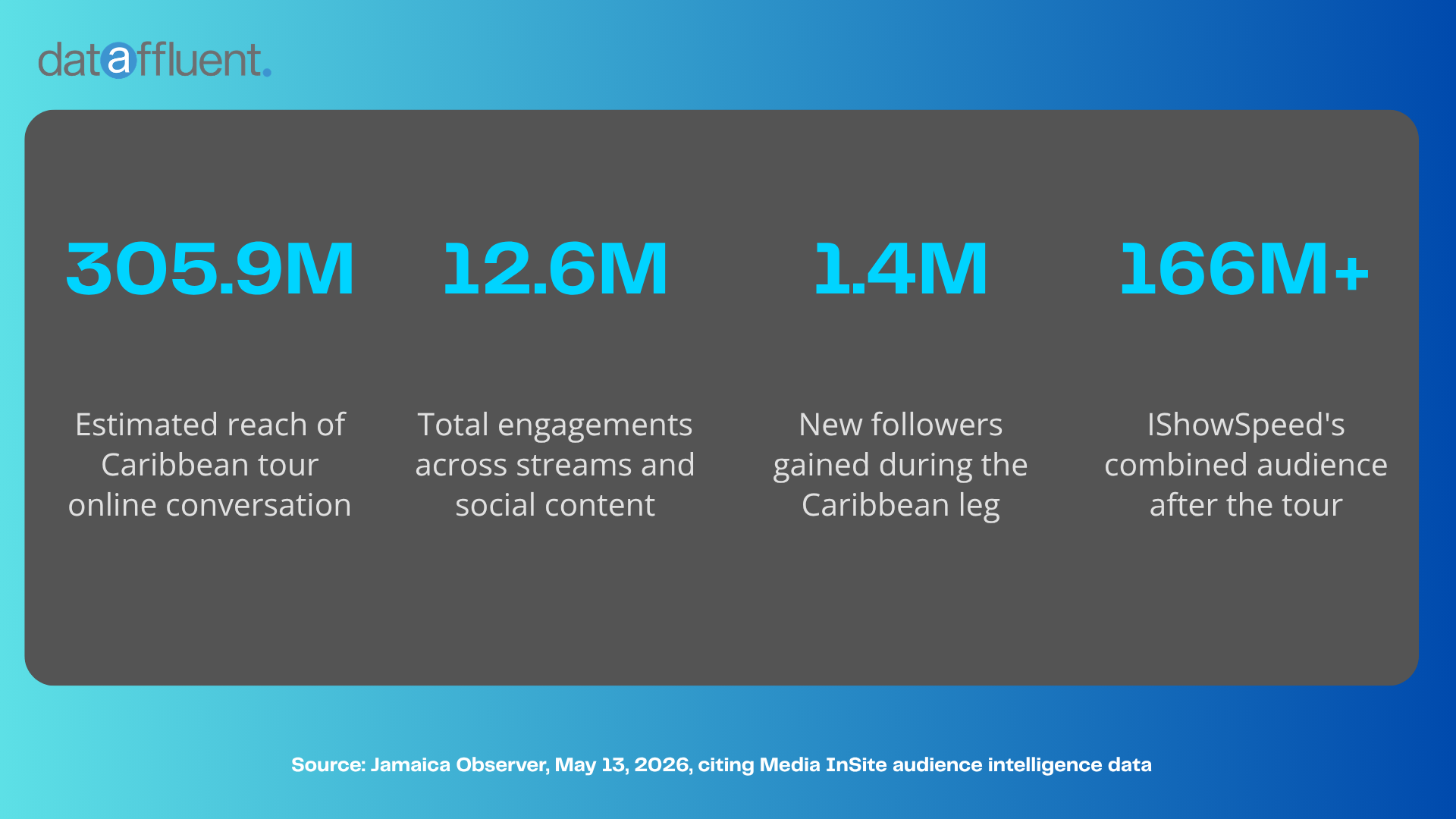
When iShowSpeed wrapped his Caribbean tour in early May, the numbers told one part of a much larger story. Millions of live streams, sold-out venues, and hundreds of thousands of young people glued to screens in real time. It was a reminder of just how deeply content and creator culture have embedded themselves into daily life across the region, and how much policy work is left to be done. The Caribbean became the backdrop for one of the largest creator-driven internet events of the year. IShowSpeed’s Caribbean tour generated approximately 12.6 million total engagements across streams and related social content. Online conversation surrounding the tour reached an estimated 305.9 million people. In Jamaica alone, the dominant audience engaging with that content was the 25 to 34 age group, representing 56.7 percent of online conversation, followed by 18 to 24-year-olds at 35.5 percent.
Those numbers tell a story about where digital attention in the Caribbean now lives, who commands it, and what moves through it. They also raise a question that the region has not yet answered with sufficient seriousness: what are we doing with that attention, and who is really capturing its value?
A highly connected region that is still primarily consuming
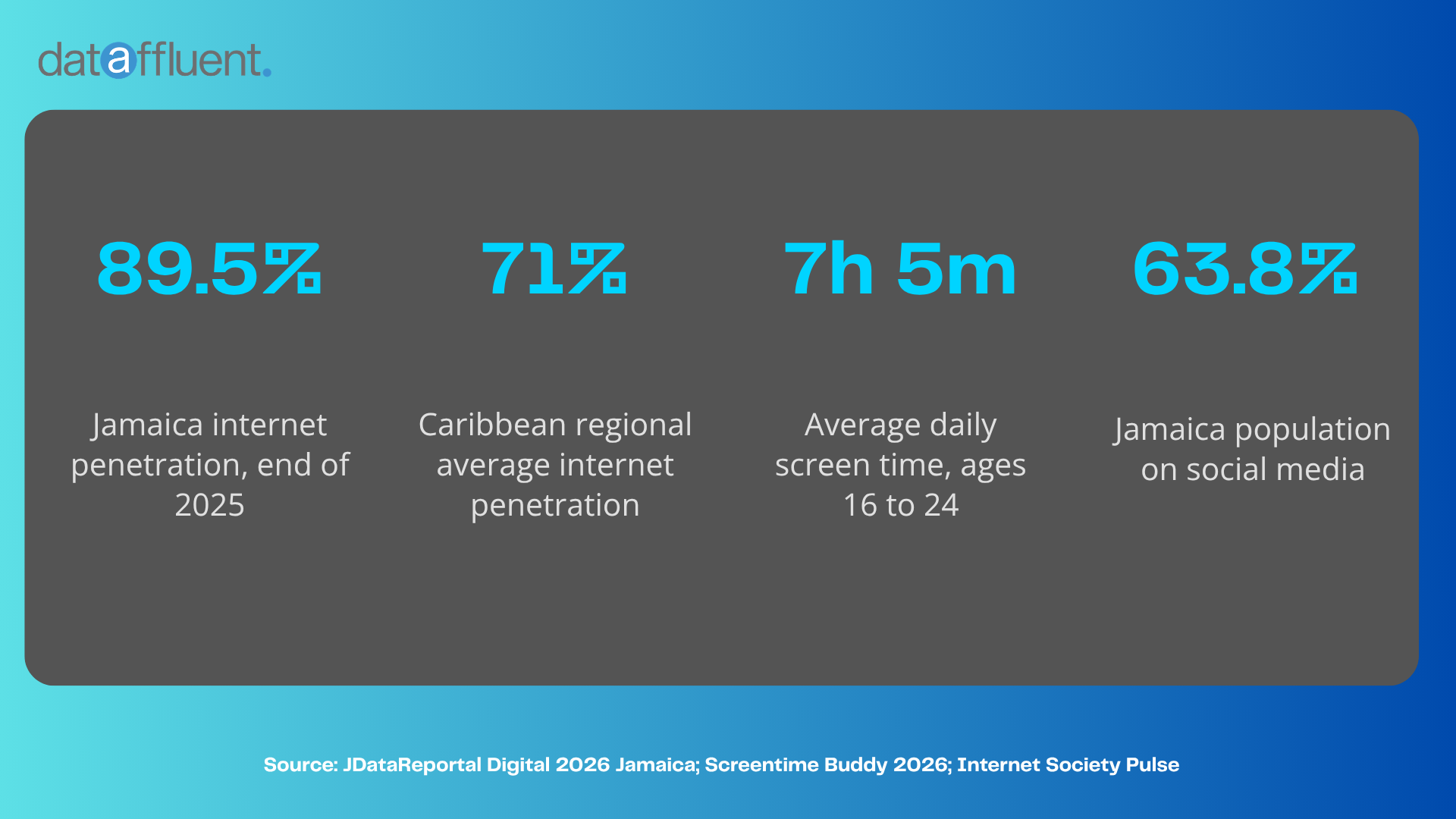
The Caribbean is no longer a region of limited connectivity. Jamaica’s internet penetration rate reached approximately 89.5 percent at the end of 2025, with 2.54 million internet users and active mobile connections equivalent to 112 percent of the total population. Across the broader Caribbean, regional internet penetration stands above 70 percent, with high-performing markets such as The Bahamas reaching 94.8 percent. Social media user identities in Jamaica alone reached 1.81 million, representing approximately 63.8 percent of the population.
On average, people globally now spend nearly 6 hours and 40 minutes looking at screens each day. Young adults between 16 and 24 average over 7 hours and 5 minutes of daily screen time. Short-form video on platforms such as TikTok, YouTube, and Instagram accounts for more than half of mobile usage within that window.
Connectivity, then, is not the problem. The more consequential gap is between how much of the Caribbean’s digital attention is consumed by external platforms and how little infrastructure exists to capture the economic and intellectual value that attention represents. The influencer economy offers one entry point into that conversation. A 2024 Jamaica Gleaner report drawing on GIP research placed Caribbean creator earning potential at between US$126 and US$37,000 per post, with follower counts ranging from 17,000 to 11 million. That is a meaningful income window, and the creator economy is a genuine opportunity for individuals across the region.
“The number of followers ranged from 17,000 to 11 million and the earning potential per post was equally as varied, ranging from US$126 to US$37,000.”
Source: Jamaica Gleaner, February 7, 2024, citing GIP research on Caribbean influencer earning potential
But individual earning potential is not the same as regional value capture. The platforms monetising Caribbean audiences at scale are headquartered and listed elsewhere. The algorithms deciding whose content gets distributed are designed and iterated on elsewhere. The corporate partnership budgets continue to favour creators in larger or more commercially familiar markets and the advertising revenue generated from hundreds of millions of impressions touching Caribbean content flows primarily to foreign shareholders. The IShowSpeed tour generated a reach of 305.9 million. The question for the region is how much of that economic energy was converted into anything lasting for Caribbean businesses, platforms, or creators, and how much simply passed through.
What the neuroscience says about where all this attention is going
The scale of short-form video consumption across the Caribbean is not simply a commercial or economic issue. It is a public health and education issue as well, and the research is increasingly clear on this point.
A June 2024 study published in Frontiers in Human Neuroscience used electroencephalogram data collected during an attention network task to measure the neurological impact of heavy short-form video consumption. Researchers found a significant negative correlation between mobile phone short video addiction tendency scores and theta power in the prefrontal region, the part of the brain most directly associated with executive control, sustained focus, and deliberate decision-making. The more addicted participants were to short-form video, the weaker their measured capacity for directed attention.
“An increased tendency toward mobile phone short video addiction could negatively impact self-control and diminish executive control within the realm of attentional functions.”
Yan et al., Frontiers in Human Neuroscience, June 2024. DOI: 10.3389/fnhum.2024.1383913
For a region where young adults aged 16 to 34 represent the dominant digital audience and where short-form video accounts for most of the mobile screen time, the implications for educational outcomes and workforce readiness are direct. This is not a moral argument about content. It is a measurable neurological finding with structural consequences for how well a generation will be equipped to learn, build, and compete.
The two versions of the same platform
Perhaps the most instructive case study in intentional digital policy is not a government report or a regulatory framework. It is a product decision made by a platform company operating two fundamentally different versions of the same product for different populations.
China’s domestic version of TikTok, called Douyin, operates under rules introduced by the Cyberspace Administration of China in 2021 and strengthened since. Users under 14 are limited to 40 minutes of daily access. The platform is unavailable between 10pm and 6am. Most significantly, the algorithm for minor accounts is configured to serve educational content: science, history, museum programming, and cultural material. The version of TikTok available across the Caribbean, the United States, and most of Europe carries none of these restrictions. It is optimised for engagement, which in this context means watch time, which means advertising revenue.
When researchers asked children in the United States what they wanted to be when they grew up, the leading answer in recent surveys was YouTuber or social media influencer. When the same question was put to children in China, the leading answer was astronaut or aerospace engineer. Some critics have described this asymmetry plainly: export what dulls the minds of foreign populations and preserve what builds intellectual capacity for your own. Whether or not one accepts the framing of deliberate geopolitical strategy, the structural reality holds. A platform that its own country of origin has decided its children may not use without strict limits is being consumed without restriction by the children of every other market it operates in. That asymmetry is worth taking seriously as a policy matter.
What the region has already committed to, and where the gap is
This is not a space where the Caribbean lacks any existing framework. CARICOM has articulated digital ambitions at the regional level for more than a decade. The Regional Digital Development Strategy, adopted by the CARICOM Secretariat, established strategic objectives around expanding ICT infrastructure, building digital skills, promoting innovation and entrepreneurship, and strengthening regional governance of digital development. The Vision and Roadmap for a CARICOM Single ICT Space, approved by Heads of Government in 2017, set out the case for a borderless regional digital market, covering cybersecurity, capacity building, and coordinated regulatory approaches.
What those documents do not yet contain is a specific, enforceable framework around social media usage, platform accountability, screen time guidance for minors, or the kind of cognitive protection policy that countries like China have implemented domestically and that France and the United Kingdom have begun to legislate. The infrastructure vision is present. The educational and attentional protection layer is absent.
That gap matters more now than it did when those documents were written, because connectivity has accelerated sharply. When CARICOM’s Regional Digital Development Strategy was first drafted, the Caribbean’s digital landscape looked very different. Today, with regional mobile connectivity exceeding population in several markets, the region is no longer in a phase of building access. It is in a phase of managing consequences, and the consequences of unmanaged, unrestricted short-form video consumption at scale are now documented in peer-reviewed literature.
What a serious regional response looks like
The IShowSpeed tour also surfaced something that digital strategist Keron Rose noted directly in his Observer analysis: the next phase cannot simply be about creating viral moments. It has to be about converting digital visibility into measurable infrastructure, whether that means tourism booking systems, searchable business listings, or AI-ready platforms that allow Caribbean businesses to compete in an increasingly algorithmic discovery environment.
That insight applies equally to the policy conversation. Viral attention is not a strategy. What the region needs is a set of deliberate, compounding investments across several areas.
First, age-appropriate screen time guidance backed by the neuroscience, developed in partnership with ministries of education and health, and communicated to families with the same urgency applied to other public health campaigns. Second, a digital literacy curriculum that teaches not just how to use platforms, but how those platforms work: how recommendation algorithms are designed, how advertising models shape content incentives, what data is collected in exchange for free access, and what the research says about attentional impact. Third, investment in Caribbean-owned digital infrastructure and content platforms, so that the value generated by regional audiences does not flow entirely outward. Fourth, an updated regional framework, built on the CARICOM ICT foundations already in place, that specifically addresses social media platform accountability, minor protection, and cognitive wellbeing as dimensions of digital development rather than afterthoughts.
None of this requires rejecting the creator economy or the genuine opportunities that platforms offer. The IShowSpeed tour demonstrated real cultural appetite, real tourism discovery potential, and real economic energy across multiple islands. That energy is worth building on. But building on it requires more than participation. It requires the kind of critical infrastructure, policy intention, and investment in human cognitive capacity that turns a moment of attention into a generation of capability.
Critical thinking, educational infrastructure, and digital balance are not in competition with AI innovation. They are the foundation it requires. The region that builds that foundation deliberately, and soon, will have a meaningful advantage in both the talent it develops and the technology it is able to create.
About Dataffluent
Dataffluent is a Techstars-backed data science and analytics company headquartered in Kingston, Jamaica. We build data products and analytical solutions that help financial institutions, investors, and businesses across underserved emerging markets move from raw data to decisions that drive measurable results. Our flagship product is a financial analyst platform purpose-built for the Caribbean capital markets. The platform delivers fundamental analysis of publicly traded companies across the region, combining machine learning-driven sentiment analysis, and macroeconomic predictions covering inflation, interest rates, and foreign exchange movements. For analysts, portfolio managers, and institutional investors operating in markets where reliable, region-specific intelligence has historically been hard to come by, this fills a critical gap. We understand the market we operate in. Fragmented data environments, thin public disclosure requirements, and the unique macroeconomic dynamics of small open economies are not edge cases for us. They are the conditions our models are trained on, and our platform is built for. Join our beta waitlist or book a demo to learn more.
References
1. CARICOM Secretariat. Regional Digital Development Strategy (RDDS). caricom.org
2. CARICOM (2017). Vision and Roadmap for a CARICOM Single ICT Space. Approved at the 28th Inter-Sessional Meeting of Heads of Government, Georgetown, Guyana. caricom.org
3. Cyberspace Administration of China (2021, updated 2023). China: Children given daily time limit on Douyin – its version of TikTok. https://www.bbc.com/news/technology-58625934
4. DataReportal (2026). Digital 2026: Jamaica. https://datareportal.com/reports/digital-2026-jamaica
5. Internet Society Pulse; Statista; Homefi Blog (2026). Caribbean and global internet penetration and screen time data. https://homefi.info/blogs/homefi-blog/internet-access-statistics
6. Jamaica Observer (May 13, 2026). “IShowSpeed: Recapping the Numbers of the Caribbean Tour.” Citing Media InSite audience intelligence data. https://www.jamaicaobserver.com/2026/05/13/ishowspeed-recapping-numbers-caribbean-tour/
7. Jamaica Gleaner (February 7, 2024). “Influencer Economy Booms — Bolt at the Helm.” Citing GIP (Global Influencer Partnership) research. https://past.jamaica-gleaner.com/article/business/20240207/influencer-economy-booms-bolt-helm
8. Taylor, Chloe (July 9, 2019). Kids now dream of being professional YouTubers rather than astronauts, study finds. https://www.cnbc.com/2019/07/19/more-children-dream-of-being-youtubers-than-astronauts-lego-says.html
9. Yan T, Su C, Xue W, Hu Y and Zhou H (2024). “Mobile phone short video use negatively impacts attention functions: an EEG study.” Frontiers in Human Neuroscience. DOI: 10.3389/fnhum.2024.1383913


0 Comments