


In May 2026, BlackRock CEO Larry Fink confirmed what institutional investors already understood: the trillions required to build AI data centres and power grids will be funded by ordinary people’s “savings accounts and pension accounts” (Yahoo Finance, 2026). The quote was fact-checked and noted as accurate and while Fink was describing where capital would flow, not issuing a directive (Yahoo Finance, 2026), the direction matters as much as the intent.
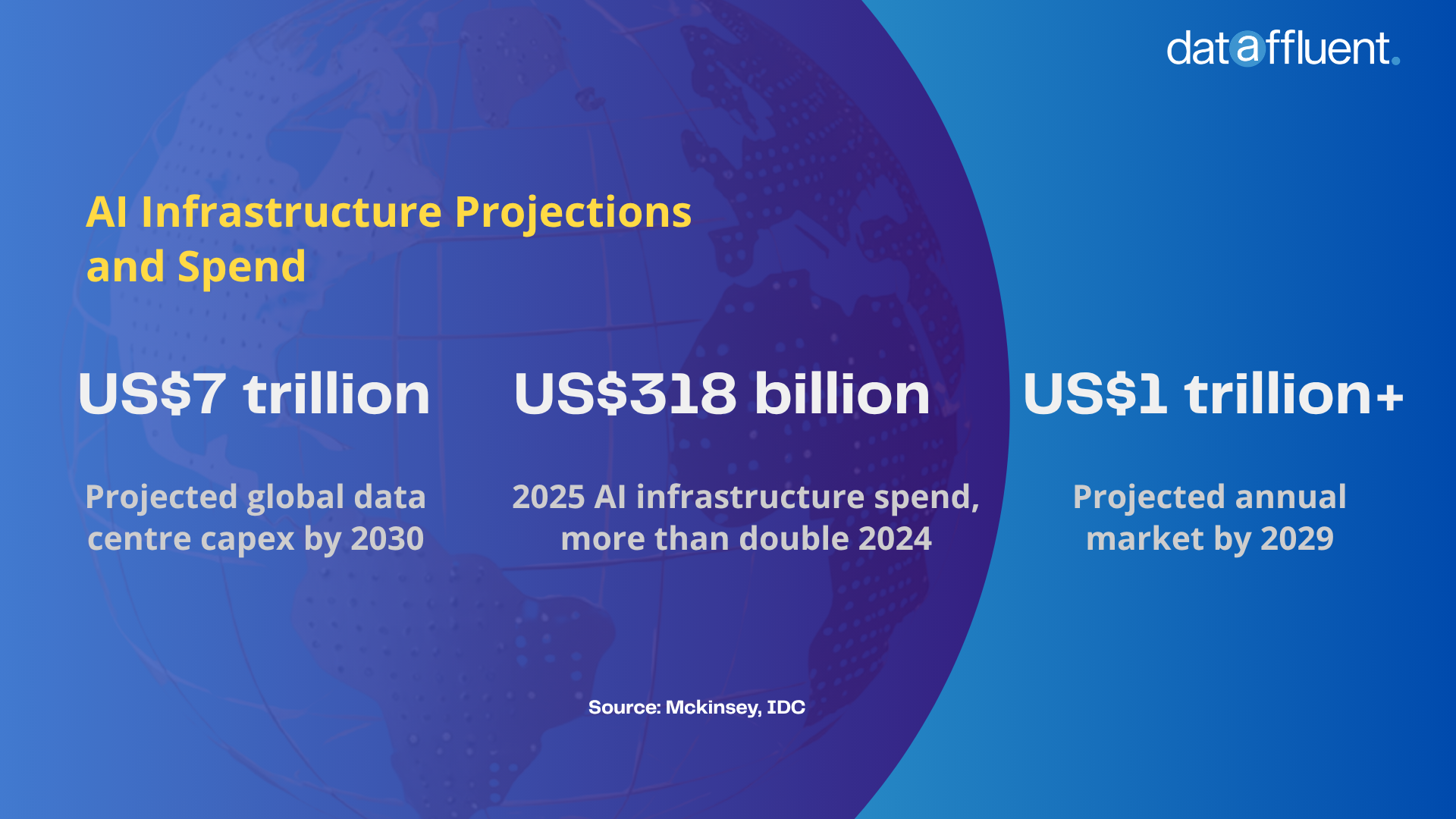
The AI infrastructure buildout is now one of the largest coordinated capital mobilisation in modern economic history. McKinsey projects global data centre capital expenditure could reach nearly USD 7 trillion by 2030 (McKinsey, 2025). IDC data shows that full-year 2025 AI infrastructure and related systems spending totalled USD 318 billion, more than double the USD 153 billion recorded in 2024, and the market is projected to surpass USD 1 trillion annually by 2029 (IDC, 2026).
The capital meeting that demand is increasingly pension capital. Canada Pension Plan Investment Board (CPP Investments) and Equinix jointly acquired atNorth Holding AB, a pan-Nordic data centre operator headquartered in Iceland, in a USD 4 billion transaction announced in February 2026. CPP Investments committed approximately USD 1.6 billion for a majority stake (CPP Investments and Equinix, 2026). That same month, Australia’s Aware Super committed AUD 460 million to a pan-APAC data centre business, pushing its total digital infrastructure portfolio beyond AUD 6 billion, representing more than a quarter of its entire infrastructure allocation (Aware Super, 2026).
Retirement savings from Canadian and Australian workers are now backing data centres in Iceland, Finland, Denmark, Malaysia, and Japan. The Caribbean’s pension systems are watching from a distance and the question this article asks is not whether the region should participate, it is what participation actually requires.
Why Iceland? Understanding the Site Selection Logic
The CPP Investments and Equinix rationale for acquiring atNorth is not arbitrary. It reflects a rigorous infrastructure investment thesis and understanding that thesis is the starting point for any serious Caribbean strategy.
Iceland offers three structural advantages that global institutional investors price into long-term infrastructure allocation. First, 100% of the country’s electricity is sourced from geothermal and hydroelectric generation, with energy rates for long-term industrial contracts offering predictable 10-year cost visibility (Data Centers by Iceland, n.d.; JSA, 2022). Second, the country’s Arctic-adjacent climate delivers year-round free air cooling, with atNorth reporting that Icelandic facilities use between 24 and 31 percent less energy than equivalent sites in the United Kingdom or the United States (atNorth, 2025). The best-in-class sites achieve a Power Usage Effectiveness (PUE) range of 1.05 to 1.2, compared to the global data centre average of 1.58 (Arizton, 2025). Third, Iceland’s subsea cable infrastructure, including connections linking North America, the United Kingdom, Ireland, and Europe, provides the low-latency global connectivity that hyperscale operators and AI workloads require (atNorth, n.d.).
Together, these factors produce a combination that pension fund infrastructure teams require: predictable operating costs, contracted renewable energy at scale, regulatory transparency, and connectivity to major demand markets. A PricewaterhouseCoopers study cited by Askja Energy showed earlier estimate for the operating expenditure of a 10,000 square foot data centre in Iceland over a 15-year period is approximately USD 130 million cheaper than running an equivalent facility in the United Kingdom or continental Europe (Askja Energy, 2013).
Institutional capital does not flow to locations, it flows to conditions, and the Nordics have built those conditions deliberately over decades.
The Three Gaps the Caribbean Must Close
The Caribbean does not need to replicate Iceland. It needs to close the specific gaps that currently place the region outside the investable universe for the category of long-duration, institutional-grade infrastructure capital that is reshaping the AI economy. Three gaps define the challenge and we have outlined these below in more detail:
Energy Cost and Reliability
The most significant barrier is power, specifically reliable and cost-effective power. For many Caribbean islands, imported crude oil or fossil fuel is the primary source of power generation. For example, in the Eastern Caribbean, over 90% of power generation still comes from imported fossil fuels (Nearshore Americas, 2026) and oil producing Guyana who lacks domestic refining capabilities exports all of its raw crude for refining and imports finished petroleum products for domestic use. Added to this reality, high electricity tariffs are the single most cited constraint on Caribbean data centre development (ResearchAndMarkets, 2022) and pension funds and infrastructure investors require predictable, low-cost power structures to model long-term return on investment. Without that, it will be near impossible to build out our version of those deals.
Progress is happening, but slowly as the World Bank approved a USD 110 million Caribbean Resilient Renewable Energy Infrastructure Investment Facility in April 2025 for Grenada, Saint Lucia, and Saint Vincent and the Grenadines, and has committed nearly USD 500 million in Caribbean renewable energy projects more broadly (Nearshore Americas, 2026). Bermuda’s Integrated Resource Plan targets 85% renewable electricity by 2035, and Panama, Jamaica, Cayman Islands, and Aruba are all advancing renewable energy programmes (ResearchAndMarkets, 2022). As of 2022, however, only about 12% of the region’s electricity came from renewables, and the gap between current grid capacity and the power reliability required for institutional-grade data infrastructure remains wide (Nearshore Americas, 2026). The speed of this transition determines the speed at which the Caribbean enters the investable universe.
Regulatory Modernisation
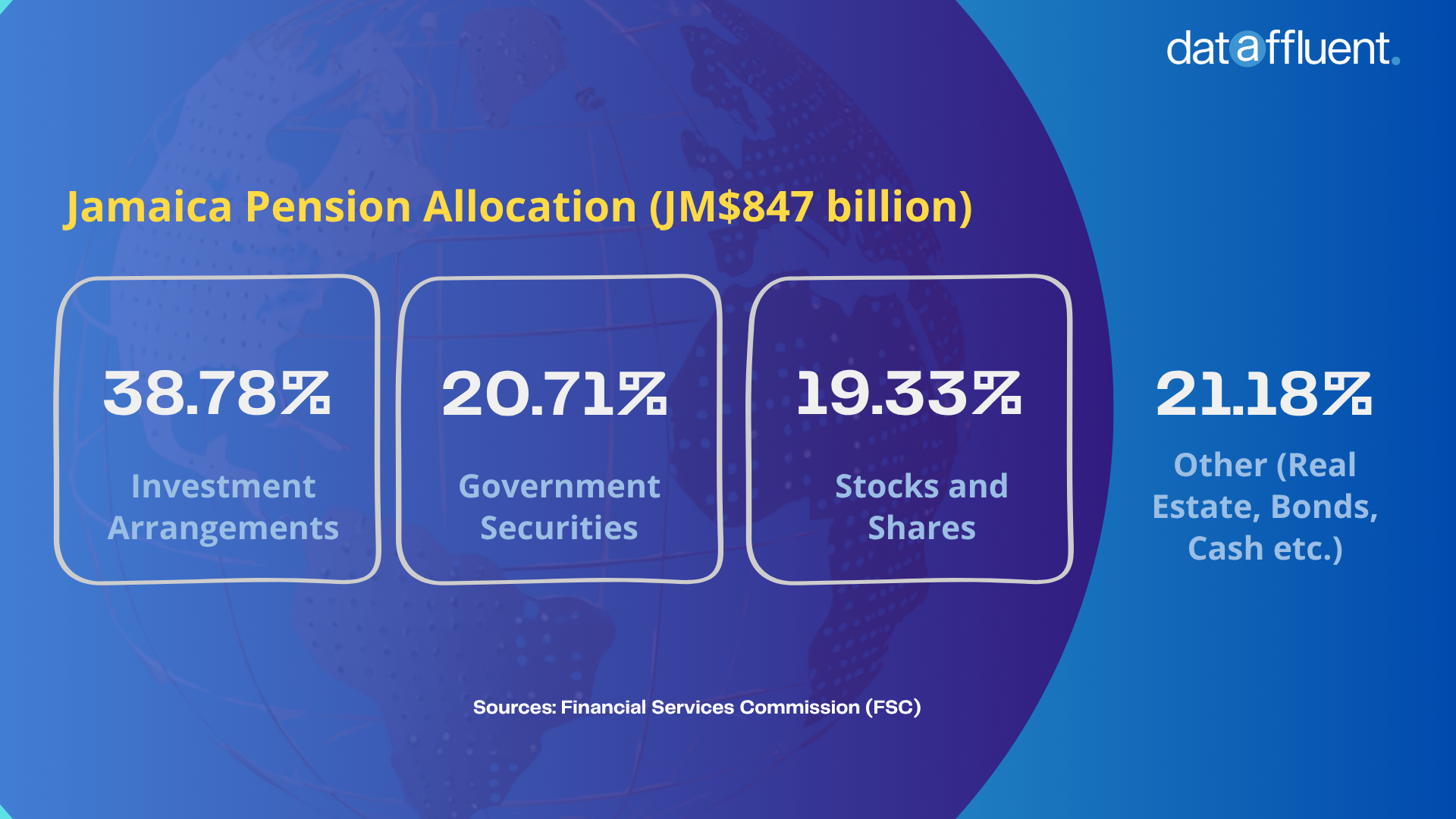
Caribbean pension funds have historically been legally constrained from directing significant capital into private, early-stage, or technology infrastructure projects. This is a structural barrier, not a market failure as we see Jamaica’s reform process illustrating both the intent and the pace problem. As at September 30, 2025, Jamaica’s private pension industry held JMD 847 billion in total assets, growing at approximately 8% annually over recent years (Financial Services Commission Jamaica, 2025). The dominant allocations are Investment Arrangements (38.78%), Securities of Governments (20.71%), and Stocks and Shares (19.33%). Under the current regulatory ceiling of 5% on private company equity investment, only roughly JMD 42.4 billion is available for such allocations (Jamaica Information Service, 2026).
Phase one of the government’s reform could unlock an additional JMD 21.2 billion. Phase two, which would raise the ceiling to 10%, was delayed by the 2025 General Election and Hurricane Melissa and remains a legislative work in progress (Jamaica Observer, 2026; Jamaica Information Service, 2026). The OECD’s 2025 Annual Survey of Investment Regulation confirms Jamaica among the jurisdictions actively updating pension investment rules and notes that global best practice has shifted toward portfolios with significant alternative and infrastructure asset exposure (OECD, 2025a). The direction is right, but the pace must accelerate.
Barbados manages 246 registered occupational pension plans as at December 2025, spanning defined benefit, defined contribution, and hybrid structures (FSC Barbados, 2025). No comparable reform process toward digital infrastructure as a permitted asset class is publicly documented. Guyana, despite extraordinary GDP growth driven by oil revenues and foreign direct investment expanding from USD 7.2 billion to USD 10.4 billion in 2024 alone (Bank of Guyana, 2024), was among a small number of jurisdictions to record a decline in pension assets in 2024, attributed partly to a lack of high-quality local investment alternatives (OECD, 2025).
Resilient Connectivity
Subsea cable capacity is a prerequisite for institutional-grade digital infrastructure, and the Caribbean’s connectivity landscape is improving but uneven. The Cayman Islands passed legislation in 2025 enabling government partnership with a private entity to build a new submarine cable. Liberty Networks restructured its Maya-1 system and is developing the Maya-1.2 replacement, which is an enhanced system that reconfigures the older route to double capacity and significantly reduce latency, ensuring critical digital infrastructure for the Caribbean and Central America. Multiple cable projects including Carnival Submarine Network-1, Celia, Nuvem, and the MANTA cable are advancing across the region (BNamericas, 2025). Google has also reportedly committed to subsea cable and connectivity investment in the Dominican Republic with a $500 million investment to build the country as a primary digital and AI hub for the Americas (Nearshore Americas, 2026).
The Caribbean Data Centre Association, led by Chairman Giovanni King, is pushing for a cluster of interconnected data centres allowing each country to host sovereign data affordably, arguing explicitly that the region has no need for electricity-guzzling mega campuses and should build to serve its own data sovereignty before trying to serve hyperscale demand (Nearshore Americas, 2026). That framing is strategically sound for a first phase. It creates the infrastructure base from which pension co-investment in larger facilities becomes a credible second phase.
The Path to a Seat at the Table
The Inter-American Development Bank published a strategic framework in October 2025 specifically addressing how Latin American and Caribbean governments can capture the data centre opportunity. It outlines a two-phase roadmap for public sector leadership in addressing infrastructure gaps, streamlining regulatory frameworks, and enabling green and resilient digital infrastructure (IDB, 2025). The framing is directly relevant to the Caribbean pension investment question.
Phase one requires governments to create the conditions: renewable energy at scale, modernised investment regulation, connectivity infrastructure, and data protection frameworks that attract operators. Jamaica, Bahamas, Panama, and Cayman Islands have already enacted personal data protection laws (ResearchAndMarkets, 2022). Guyana signed a memorandum of understanding with Cerebras Systems in late 2025 to develop an AI-focused data centre of up to 100 megawatts, a signal that Caribbean governments are beginning to move from policy discussion to transaction (Nearshore Americas, 2026).
Phase two is where pension capital enters. Once institutional-grade infrastructure exists, regional pension funds, operating through pooled vehicles or regional co-investment structures, can deploy capital into these assets and earn the long-duration infrastructure returns currently going to CPP Investments and Aware Super. Jamaica’s 820 pension plans, of which 740 hold assets, represent a fragmented landscape (FSC Jamaica, 2025) and pooling mechanisms, whether through CARICOM institutional frameworks or purpose-built infrastructure funds, are the instrument through which smaller plans access infrastructure returns without unsustainable concentration risk.
The IDB and World Bank are already financing the foundational layer. Multilateral development banks including BNDES, IDB, and IFC are backing data centre projects across Latin America (BNamericas, 2025). Caribbean pension capital, properly structured and regulated, is the natural next tier of the capital stack.
The Cost of Watching
The seat at the table is not given, it is built. The Nordics earned institutional investor attention through decades of deliberate energy, regulatory, and connectivity investment. The Caribbean’s version of that story is being written now, and the choices made in the next three to five years will determine whether regional pension contributors benefit from the AI infrastructure boom or simply pay for the services built with someone else’s retirement savings.
The data is clear on what is required: low-cost renewable energy at grid scale, a pension regulatory framework that permits infrastructure allocation, subsea connectivity that meets hyperscale latency standards, and governance environments that support long-term capital commitment. None of these are beyond the Caribbean’s reach and some are already partially in place.
This is not a case for waiting until conditions are perfect before moving. It is a case for treating digital infrastructure investment readiness as an economic priority with the same urgency that the region applies to tourism and financial services development. The capital is moving, building the conditions to receive it is the work in front of us.
About Dataffluent
Dataffluent is a Techstars-backed data science and analytics company headquartered in Kingston, Jamaica. We build data products and analytical solutions that help financial institutions, investors, and businesses across underserved emerging markets move from raw data to decisions that drive measurable results. Our flagship product is a financial analyst platform purpose-built for the Caribbean capital markets. The platform delivers fundamental analysis of publicly traded companies across the region, combining machine learning-driven sentiment analysis, and macroeconomic predictions covering inflation, interest rates, and foreign exchange movements. For analysts, portfolio managers, and institutional investors operating in markets where reliable, region-specific intelligence has historically been hard to come by, this fills a critical gap. We understand the market we operate in. Fragmented data environments, thin public disclosure requirements, and the unique macroeconomic dynamics of small open economies are not edge cases for us. They are the conditions our models are trained on, and our platform is built for. Join our beta waitlist or book a demo to learn more.
References
Arizton. (2025). Iceland data center market size, growth, investment analysis. https://www.arizton.com/market-reports/iceland-data-center-market
Askja Energy. (2013, March 4). Data centers in Iceland offer dramatic savings. https://askjaenergy.com/2013/03/04/data-centers-in-iceland-offer-dramatic-savings/
atNorth. (2025). How environmentally friendly are Iceland’s data centers? Part 3. https://www.atnorth.com/in-the-news/how-environmentally-friendly-are-icelands-data-centers-part-3/
atNorth. (n.d.). Nordic data centers: Iceland. https://www.atnorth.com/nordic-data-centers/iceland-data-centers/
Aware Super. (2026, January 20). Aware Super extends digital infrastructure footprint with US$300 million APAC data centre business investment. https://aware.com.au/member/about-us/newsroom/january-2026/aware-super-extends-digital-infrastructure-footprint-with-us-300-million-apac-data-centre-business-investment
Bank of Guyana. (2024). Half-year report 2024. https://bankofguyana.org.gy/bog/images/research/publications/Half%20Year%20Report%202024.pdf
BNamericas. (2025, December 31). Submarine cables, 5G and reconstruction reactivate Caribbean digital infrastructure. https://www.bnamericas.com/en/news/submarine-cables-5g-and-reconstruction-reactivate-caribbean-digital-infrastructure
BNamericas. (2026, February 18). Caribbean governments drive data center investment. https://www.bnamericas.com/en/interviews/caribbean-governments-drive-data-center-investment
CPP Investments and Equinix. (2026, February 27). CPP Investments and Equinix to acquire atNorth for US$4 billion [Press release]. https://newsroom.equinix.com/2026-02-27-CPP-Investments-and-Equinix-to-Acquire-atNorth-for-US-4-Billion
Data Centers by Iceland. (n.d.). Why Iceland? https://www.datacentersbyiceland.com/
Financial Services Commission Barbados. (2025). FSC Barbados registered pension plans. https://www.fsc.gov.bb/
Financial Services Commission Jamaica. (2025, January). Pensions industry statistics report: September 2025. https://www.fscjamaica.org/wp-content/uploads/2026/01/Pensions-Industry-Statistics-September-2025.pdf
Garcia Zaballos, A., Puig Gabarro, P., Iglesias Rodriguez, E., and Perez Colon, R. (2025). Capturing the data center opportunity in Latin America and the Caribbean. Inter-American Development Bank. https://publications.iadb.org/en/capturing-data-center-opportunity-latin-america-and-caribbean
International Data Corporation. (2026, April 16). AI infrastructure spending caps historic year at ~$90 billion in Q4 2025; 2029 spending to eclipse $1 trillion. https://www.idc.com/resource-center/blog/ai-infrastructure-spending-caps-historic-year-at-90-billion-in-q4-2025-2029-spending-to-eclipse-1-trillion/
Jamaica Information Service. (2026). Gov’t to increase share of pension fund investment in private entities. https://jis.gov.jm/govt-to-increase-share-of-pension-fund-investment-in-private-entities/
Jamaica Observer. (2026, March 10). Budget debate: Gov’t encourages pension funds to invest more in private companies. https://www.jamaicaobserver.com/2026/03/10/budget-debate-govt-encourages-pension-funds-invest-private-companies/
JSA. (2022, November 1). Building data centers in Iceland: The land of fire and ice. https://www.jsa.net/building-data-centers-in-iceland-the-land-of-fire-and-ice/
McKinsey and Company. (2025, April 28). The cost of compute: A $7 trillion race to scale data centers. https://www.mckinsey.com/industries/technology-media-and-telecommunications/our-insights/the-cost-of-compute-a-7-trillion-dollar-race-to-scale-data-centers
Nearshore Americas. (2026, February 26). Small islands, smart strategy: Caribbean rewrites data center model. https://nearshoreamericas.com/small-islands-smart-strategy-caribbean-rewrites-data-center-model/
Organisation for Economic Co-operation and Development. (2025). Pension markets in focus 2025: Preliminary 2024 data. https://www.oecd.org/content/dam/oecd/en/topics/policy-sub-issues/asset-backed-pensions/PMF%202025%20-%20Preliminary%202024.pdf
Organisation for Economic Co-operation and Development. (2025a). Annual survey of investment regulation of pension providers 2025. https://www.oecd.org/content/dam/oecd/en/topics/policy-sub-issues/asset-backed-pensions/2025-Annual-Survey-of-Investment-Regulation-of-Pension-Providers.pdf
ResearchAndMarkets. (2022). Caribbean data center market: Investment analysis and growth opportunities 2022-2027. Arizton. https://www.globenewswire.com/news-release/2022/09/02/2509260/0/en/Caribbean-Data-Center-Market-Investment-Analysis-Report-2022-2027-Focus-on-Bahamas-Jamaica-Panama-Cayman-Islands.html
Yahoo Finance. (2026). Larry Fink warns Americans’ pensions and savings accounts can fund the trillions required for AI data centers. https://finance.yahoo.com/markets/stocks/articles/larry-fink-warns-americans-pensions-113500059.html


0 Comments